




Report
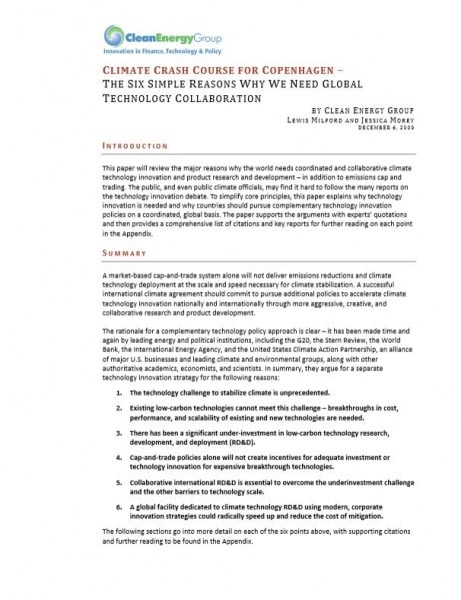
This brief 8-page document addresses the “why” of international technology collaboration — the basic reasons why global technology policies – for product development — beyond cap and trade are needed for stabilization.
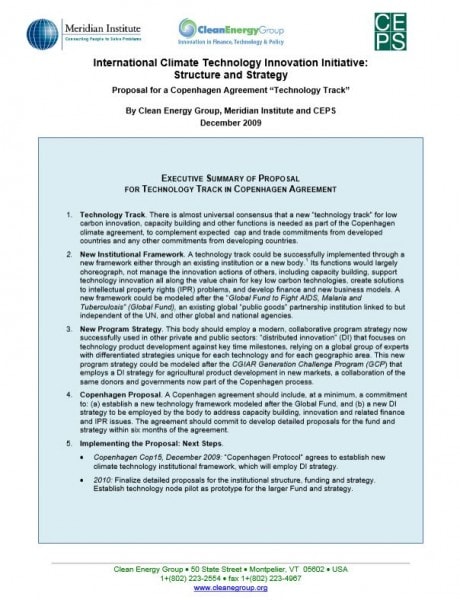
This report makes recommendations for how an international technology collaboration could be structured.
This report from Clean Energy Group and the Meridian Institute recommends that the Obama Administration should use corporate “open and distributed innovation” strategies to accelerate research and development for clean energy and climate change technologies.

This report informs states on how they can act more like retail marketers to establish the financial and energy value of solar technology for the consumer.
This paper sets out some countervailing arguments that governments and other donors should not be in the business of picking winners. The authors argue that technology-based policy and incentives are needed to address long term climate stabilization.
This report outlines a new approach to the climate innovation process.

This report describes the key policies and program strategies that have emerged as effective tools for states to advance wide-spread solar deployment.
This paper notes that the advances in technology, the increase and changing needs for standby generation, and environmental concerns suggests a new look at standby generation codes and standards.
This report is based on a background study and seminar on Strategic Aspects of Technology for the UNFCCC and Climate Change Debate: The Post-Bali Technology Agenda, organized under the auspices of the European Climate Platform (ECP), a joint initiative of Climate Policy Research Programme and Centre for European Policy Studies.
This paper proposes a specific structure for a new “distributed innovation” approach to climate technology, building and expanding on the earlier recommendations of the UN Foundation and the Club of Madrid.