




Fact Sheet

Solar combined with energy storage (solar+storage) can provide cost savings and keep essential services powered during grid outages. Clean Energy Group has published a series of short fact sheets answering the following frequently asked questions about solar+storage: These fact sheets are adapted from Clean Energy Group’s 2024 publication, Understanding Solar+Storage: Answers to Commonly Asked Questions…
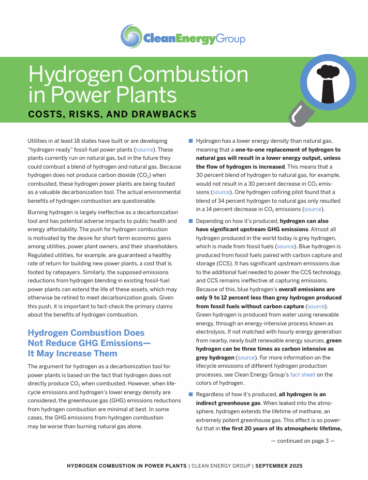
Green hydrogen and green ammonia are touted as potential replacements for fossil fuels, but their actual environmental benefits are questionable. This fact sheet looks at the risks of hydrogen combustion.

Green hydrogen and green ammonia are touted as potential replacements for fossil fuels, but their actual environmental benefits are questionable. This fact sheet investigates the pros and cons of green ammonia.
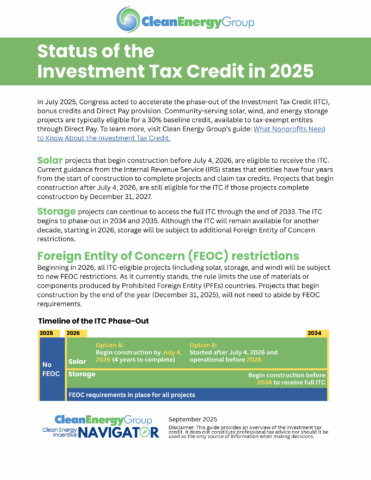
In July 2025, Congress acted to accelerate the phase-out of the Investment Tax Credit (ITC), bonus credits and Direct Pay provision. Community-serving solar, wind, and energy storage projects are typically eligible for a 30% baseline credit, available to tax-exempt entites through Direct Pay. This fact sheet provides a timeline for the ITC eligibility of both…
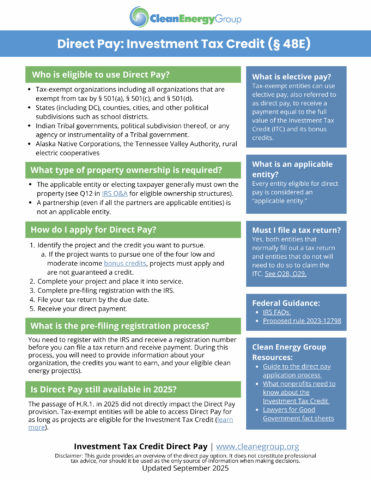
This Direct Pay Fact Sheet details which types of tax-exempt entities are eligible to receive direct pay, outlines the process to receive direct pay, and introduces additional resources.
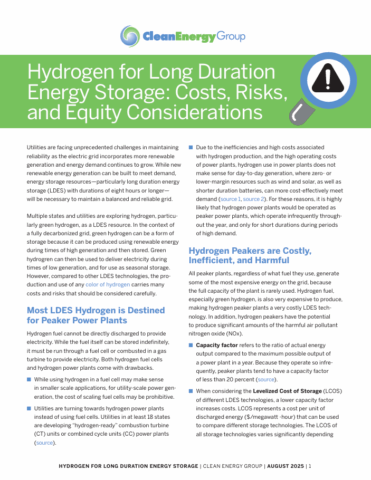
This fact sheet evaluates the viability of hydrogen as a long duration energy storage (LDES) technology. It examines the costs, efficiency, infrastructure considerations, and potential harms of hydrogen power plants.
This fact sheet covers the inefficiencies of hydrogen liquefaction, on top of the existing inefficiencies of hydrogen production. It details the high costs, high energy consumption, losses due to evaporation, safety concerns, storage and transportation issues, and global warming impacts of hydrogen liquefaction.
Hydrogen is a colorless gas that can be produced through a wide range of methods using a variety of raw materials or “feedstocks,” such as coal, natural gas, and water. Different production processes for hydrogen gas result in distinct byproducts like carbon dioxide, solid carbon, and oxygen. These differing processes are often assigned a color,…

The Greenhouse gases, Regulated Emissions, and Energy use in Technologies (GREET) model is used to determine the lifecycle emissions of various energy sources, expressed as carbon equivalent emissions, and creates the framework for many monetary and market incentives related to energy production. In some cases, the values, assumptions, and calculations within each GREET model have…

The U.S. Treasury Department released final guidance on the 45V Clean Hydrogen Production Tax Credit in January 2025. While the guidance did contain the vital “three pillars” of incrementality, temporal matching, and deliverability, which are essential for ensuring hydrogen production does not lead to a massive increase in grid emissions, it also contains several concessions…
- « Previous
- 1
- 2
- 3
- 4
- Next »