




Publications Library
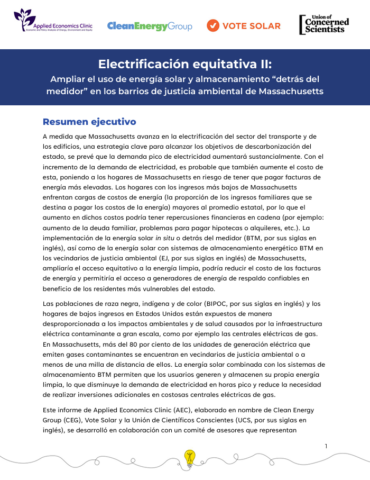
A medida que Massachusetts avanza en la electrificación del sector del transporte y de los edificios, una estrategia clave para alcanzar los objetivos de descarbonización del estado, se prevé que la demanda pico de electricidad aumentará sustancialmente. Con el incremento de la demanda de electricidad, es probable que también aumente el costo de esta, poniendo…
Massachusetts has some of the best solar and energy storage programs in the country, but these programs lack meaningful equity provisions, and clean energy adoption rates in environmental justice communities are low. Solar and storage can provide many benefits that would be especially valuable to environmental justice communities, such as lowering energy costs, reducing local…
To meet its emissions reduction targets and decarbonization goals, Massachusetts – like many states – is working towards the electrification of its building and transportation sectors. While this will help reduce air pollution, it will also increase the region’s electric demand, which could lead to a new round of investment in fossil fuel generation. This…
CEG submitted comments to the Massachusetts Department of Energy Resources (DOER) in response to DOER’s request for stakeholder feedback regarding the Advancing Massachusetts Power (AMP) straw proposal.
A Massachusetts pilot program provides a replicable and scalable model for bringing renewable energy, battery storage, and electrification to low-income households. The Cape and Vineyard Electrification Offering (CVEO) is run by the Cape Light Compact, an energy services provider serving 210,000 customers in 21 towns on Cape Cod and Martha’s Vineyard. The CVEO pilot is…

This issue brief, released by CEG and CESA, outlines best practices and lessons learned for state policymakers and regulators engaged in developing energy storage peak demand reduction programs. The brief explores key elements of program design, such as incentive mechanisms and dispatch methods, as well as considerations for incentivizing load reduction versus power export, and peak demand reduction versus emission reduction.
The Commonwealth of Massachusetts is a national leader in clean energy policy. In recent years, it has adopted ambitious energy storage procurement targets supported by innovative policies and programs, which are entering a period of internal review. The Commonwealth also has a long-held commitment to equity in its clean energy programs. Against this backdrop, Clean…

Clean Energy Group (CEG) submitted comments regarding the Connecticut Public Utilities Regulatory Authority’s annual Energy Storage Solutions (ESS) program review. The comments focus on multifamily affordable housing participation in the program and the benefits of energy storage for residents. CEG proposes that the Public Utilities Regulatory Authority consider establishing additional adders in the ESS program…
This analysis demonstrates that battery storage can cost effectively replace aging fossil-fueled peaker power plants in New England.
Comments on the Repeal of Greenhouse Gas Emissions Standards for Fossil Fuel-Fired Electric Generating Units
Clean Energy Group (CEG) submitted these comments to U.S. Environmental Protection Agency (EPA) administrator Lee Zeldin in regards to Docket ID No. EPA-HQ-OAR-2025-0124.